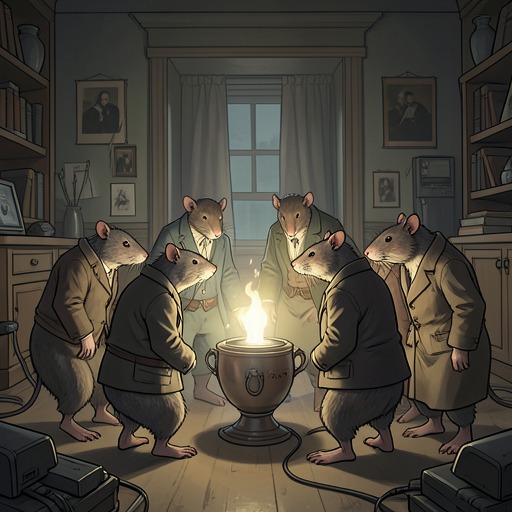
A bunch of rats is just a big animal with lots of legs and no brain
The Amazing Maurice and His Educated RodentsMaurice’s description of a frightened crowd of rats as “a big animal with lots of legs and no brain” is both a warning about panic and a claim the story puts under pressure. He uses it to explain why rats in a mass may fail to act with the courage or judgment of an individual; Peaches and Dangerous Beans challenge that reduction, and The Clan’s later actions show that a group can coordinate rather than merely react.
Meaning and immediate context
The expression arises as Maurice explains rat-coursing to Darktan and the others. He recounts men shutting barn doors, building a large round wooden wall in the middle of the floor, tipping live rats from boxes into the enclosure, and releasing terriers among them. The rats mostly ran around and around. When Darktan asks why they do not fight the dogs, Maurice answers that they are surrounded by many rats, all steeped in one another’s fear and panic. The scene makes the phrase concrete: the crowd’s shared terror overwhelms the capacity for individual resistance.
Maurice distinguishes between a single rat, which can think and be brave, and a mass whose behavior becomes something animal-like and unreasoning. The image’s many legs evoke how the crowd can move as one body, while the absence of a brain denies it deliberation. This is Maurice’s explanation of the rats in the rat-coursing ring, not a neutral rule that every group must behave that way. Darktan’s response supplies an immediate individual counterexample: he says he once bit a dog on the nose. His boast establishes that a rat can resist a dog, but it does not by itself answer Maurice’s point about what happens when fear spreads through a crowd.
The challenge from Peaches and Dangerous Beans
Peaches directly rejects the expression’s bleak conclusion. When Maurice describes the crowd as a mindless mass, she replies, “Together we are strong!” Her answer shifts the emphasis from what a group is to what its members can accomplish together. In the exchange, the two ideas are not simply competing descriptions of size: Maurice stresses the danger of shared panic, while Peaches insists that association can also create strength.
The claim continues to trouble Dangerous Beans after Darktan has moved on. Left with Peaches and Maurice, he returns to the question of whether Maurice is right that a group of rats is merely a mob. Maurice does not simply defend his earlier judgment. He interrupts the discussion to warn that something in a cellar is getting into people’s heads, suggesting that the immediate crisis may help explain how fear can take hold. Peaches observes that the influence did not frighten her, Dangerous Beans, or Darktan, but made Hamnpork very angry. Their differing reactions complicate any account of a crowd as having one shared mind: the same disturbing presence affects different rats differently.
Panic and the loss of collective capacity
Elsewhere, the story shows how fear can make rats lose more than courage. As Peaches urges the others to return and find out what has been discovered, three rats run past trailing fear. One squeals at her, gibbers madly at Dangerous Beans, and keeps running. Dangerous Beans recognizes the alarming change: they have forgotten how to talk. Peaches snatches up her notes, treating the frightened rats as evidence that something terrible has happened. The passage does not repeat Maurice’s phrase, but it dramatizes its central danger: panic can disrupt communication, the capacity that makes considered cooperation possible.
The distinction matters because Maurice’s metaphor is not borne out merely by the existence of many rats. The frightened rats’ behavior is marked by an apparent loss of language and shared deliberation; the danger lies in what fear does to their ability to act together. The episode thus gives substance to Maurice’s explanation without making it the final word on collective life. A crowd may become disorganized, but the story also presents forms of collective action that depend on communication, a common purpose, and coordination.
The Clan as a counterexample
The Clan’s sense of collective identity is expressed before the later confrontation. Dangerous Beans argues that fire must be controlled and explains that, with its flame, the rats make a statement to the darkness: they are separate, not merely rats, but The Clan. Hamnpork dislikes the candle and regards its use as a waste of food, while Dangerous Beans treats it as a sign of shared identity. The flame therefore links practical control to a collective understanding of who the rats are; the group is not just a mass assembled by proximity.
Darktan later uses language of that kind to rally a squad facing an unknown danger underground. He acknowledges that there is something new below, then presents the rats themselves as something tough and strong: rats with brains, able to think and not simply turn and run. His speech names concrete fears—darkness, fire, noises, traps, and poisons—and sets the squad a common objective: find the thing hidden behind their fear and drag it out. The contrast with Maurice’s expression is sharp. The squad’s strength does not come from having no fear, but from being addressed as thinking individuals capable of acting together despite it.
The Clan’s assault gives that contrast a visible form. Rats enter the room together and spread into a slowly advancing line. When an enemy rat attacks, the line closes over it like a fist; when it opens again, the attacker is dead. The formation depends on each rat’s relation to the others, rather than on a single courageous individual. Yet the passage preserves the fragility Maurice identified: when the surviving enemy rats smell their fellows’ terror and try to flee, the advancing line breaks into pairs that hunt them down. The fight ends seconds after it begins. The Clan’s action is not a simple denial that group fear exists; it shows a disciplined collective capable of purposeful movement, while also registering how terror changes the shape of a group’s behavior.
Narrative significance
The expression names one possible outcome of collective life, not its inevitable nature. Maurice’s rat-coursing account explains how fear shared among a crowd can make individual bravery difficult to sustain. Peaches’s answer and Dangerous Beans’s continued questioning keep that claim open to challenge, while The Clan’s identity and coordinated attack provide evidence that cooperation can give a group capacities no isolated rat possesses.
The story’s distinction is therefore between a crowd governed by contagious panic and a community whose members can think, communicate, and act toward a shared purpose. Maurice’s vivid image remains useful precisely because it is not the whole truth: the danger it describes recurs, but The Clan demonstrates that many rats need not amount to one mindless animal. Collective strength depends on how the group is formed and what its members do together.